1,200% jump in kratom-related calls to poison control centers over past decade, analysis shows

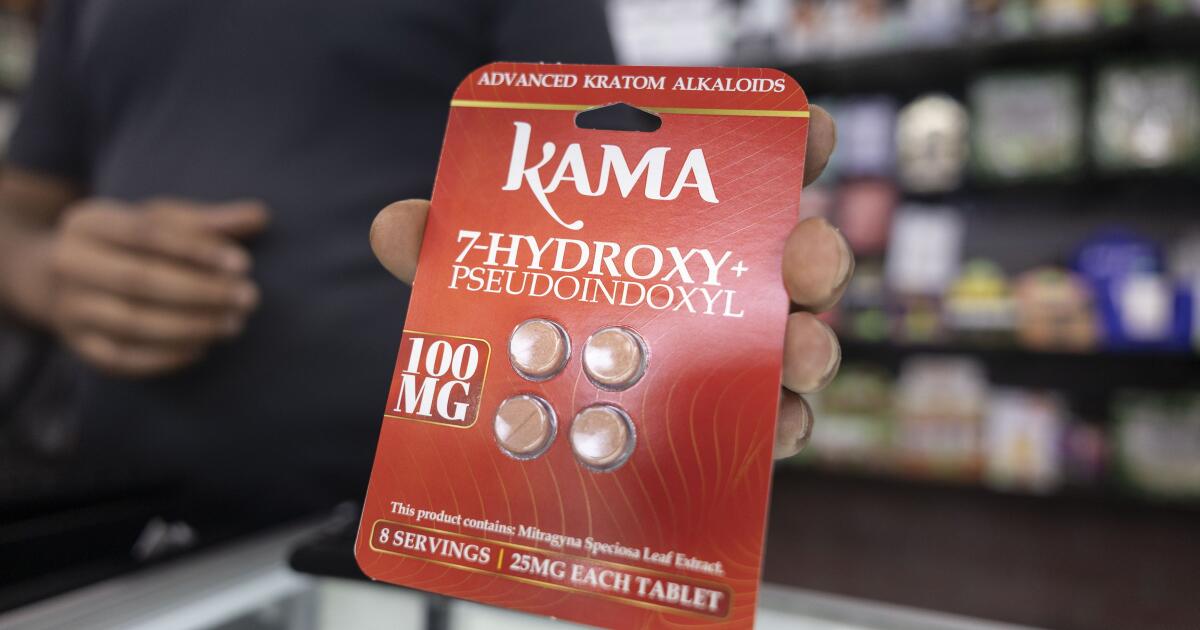
Over the past decade, poison control centers across the country have received tens of thousands of calls from consumers of kratom products reporting negative and life-threatening health effects, with researchers saying the 2025 reports have reached a new high. The California poison center reports similar findings.
Last month, researchers analyzed data from the National Poison Data System and found that between 2015 and 2025, poison control centers nationwide received 14,449 calls related to kratom. More than 23% of those calls, or 3,434, were made last year, according to a report published by the Centers for Disease Control and Prevention. That represents an increase of more than 1,200% since 2015, when only 258 calls were reported.
Police collect illegally grown kratom plants in 2019 in Phang Nha province, Thailand. The country legalized the possession and sale of kratom in 2021.
(Associated Press)
Kratom is found in the leaves Mitragyna speciosa, a tree native to Southeast Asia. It has a long history of being used for chronic pain or to increase energy and in the US, research points to Americans also using it to reduce anxiety. At low doses, kratom appears to act as a stimulant but at high doses, it can have opioid-like effects.
But in the past few years, a synthetic form of kratom that has been refined for its psychoactive compound, 7-hydroxymitragynine or 7-OH, has entered the market in a highly concentrated and unlabeled manner, leading to confusion and problems for consumers. The synthetic form gaining momentum on the market is raising concerns among public health officials because of its ability to bind to opioid receptors in the body, making it highly addictive.
Los Angeles County leaders, on the other hand, have struggled to separate the two and regulate products that come as powders, pills and drinks and have been linked to deaths in six counties. The sale of kratom and 7-OH products was banned in the region in November.
In reviewing the data, which did not distinguish whether callers consumed natural or synthetic kratom, the researchers set out to understand the impact of what they believe is a “rapidly evolving kratom market,” and highlighted the role poison centers play as an early warning monitoring system for new trends.
Findings from the National Poison Data System
The data showed that over the past 10 years, kratom-related calls to poison control centers came from people who claimed to have taken the drug alone, while another 38% came from people who mixed it with another substance or substances.
Those who consume kratom often combine it with one or a combination of the following: alcohol, opioids, benzodiazepines (such as Xanax or Valium), cannabis and cannabinoids, stimulants and antidepressants.
The data also breaks down kratom-related hospitalizations — adults who take it alone or in combination and experience “adverse” health effects; and adults who take it alone or in combination and experience “moderate” or “severe” serious health effects, including death.

Kratom powder products are displayed in a smoke shop in Los Angeles in 2024.
(Michael Blackshire/Los Angeles Times)
Hospitalizations of adults who took kratom alone and experienced adverse effects increased from 43 in 2015 to 538 in 2025. Of those who took it in combination and were hospitalized with an adverse health outcome, the number jumped from 40 in 2015 to 549 last year.
The numbers were even higher for hospitalizations where health outcomes were more serious or fatal.
In 2015, there were 76 reports of people being hospitalized after taking kratom alone and experiencing serious health effects or death. Last year, that number had risen to 919. Reports of serious adverse health effects, including death, for those taking kratom in combination with another substance increased from 51 in 2015 to 725 last year.
The study did not break down kratom-related deaths per year but said there were 233 deaths during the 10-year study period, or just over 3% of all 7,287 serious medical outcomes. Of the total number of kratom-related deaths, 184 cases involved the use of multiple substances.
That’s what California’s poison control system found in its state data
The California Poison Control System is currently reviewing its data on kratom-related calls but a preliminary analysis shows similarities to the national report, said Rais Vohra, medical director of the state’s poison control system.
“We have about 10% of the country’s population and 10% of the national poison control call volume,” Vohra said. “And, not surprisingly, we were able to identify more than 900 cases of kratom-related calls during that time.”
Local researchers are still sorting out the country’s data but they also found that kratom-related calls are on the rise.
“It’s growing fast, which I think is one of the key points for the team [published] report,” said Vohra.
Most calls that poison control receives come from health facilities where “someone may have a problem … severe enough to call 911 or go to the emergency room, and that’s when our agency gets involved,” Vohra said.
Kait Brown, clinical executive director of America’s Poison Control Centers, said the fact that kratom and 7-OH are unregulated products sold online, at gas stations and smoke shops makes it easy for people across the country to access.
And while kratom enthusiasts have maintained that it’s been used in its natural form for centuries, “there’s a new formulation that’s a little bit different than how people have used it, at least historically,” said William Eggleston, a pharmacist and assistant clinical director of the Upstate New York Poison Center in Syracuse.
People no longer consume kratom only as a powder or capsule but also in the form of energy shots or extracts; are similar to synthetic, highly concentrated 7-OH products.
When regional poison control centers compare their findings and experiences with an analysis of calls in the National Poison Data System, Eggleston said, “there is definitely an increase in kratom-related calls.”
“But if you put it in a larger area of all the calls … this is still a very small percentage of what we deal with every day,” he said.