Transcript: Israeli Ambassador Michael Leiter on “Face the Nation with Margaret Brennan,” July 12, 2026

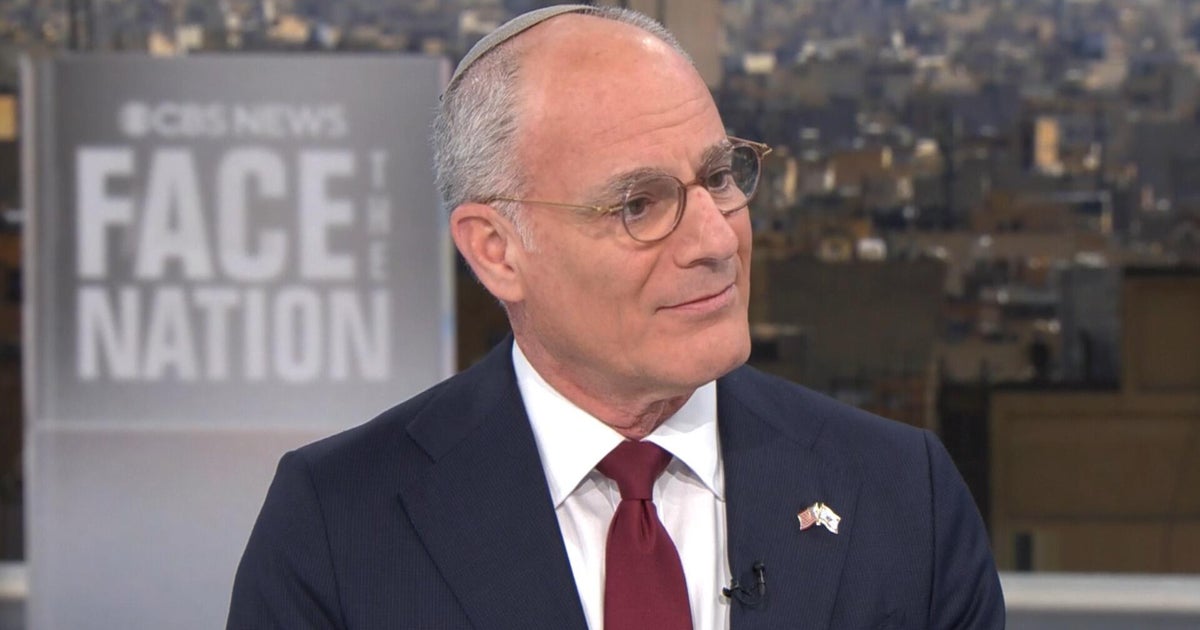
The following is the transcript of an interview with Israeli Ambassador to the US Michael Leiter that aired on “Face the Nation with Margaret Brennan” on July 12, 2026.
MARGARET BRENNAN: We are now joined by Israel’s ambassador to the United States, Dr. Michael Leiter. Good to have you back here.
ISRAELI AMBASSADOR MICHAEL LEITER: Hello. Your Prime Minister this morning was honoring Senator Lindsey Graham. I know he was a fierce advocate for Israel, and he really pushed for relations between Israel and Saudi Arabia. Three weeks ago, on this show, he did that. I wonder if he thinks there is any way to carry on his legacy by continuing that kind of diplomatic work.
AMB. LEITER: Sure, Lindsey was a dear friend. My first day in Washington, January 27 2025, the first phone call I got when I got to my seat in the embassy was from Lindsey Graham. He said, “can we have dinner tonight?” And we’ve been talking generally in the Middle East for the last year and a half. And he was not only a ferocious advocate of defeating the Iranian regime, he was also a ferocious advocate of what would happen after that. And he saw, he had a vision for peace in the Middle East. And of course, we have to work for that, but it will definitely happen if his first part of that vision is fulfilled, and that Iran is no longer a regional hegemon that threatens its neighbors.
MARGARET BRENNAN: Three weeks ago, Lindsey Graham said on this show, 2026. That was her promise that normalcy would happen. So we will have to follow that.
AMB. LEITER: We still have time.
MARGARET BRENNAN: We still have time. Let me ask you about another important overnight development with Iran. An attempt to renew the agreement between the United States and Iran has apparently recently collapsed. This was just a stopgap attempt to reopen the Strait of Hormuz. In fact, it was limited in scope. But the IRGC fired on the merchant ship. The United States has resumed bombing. So far, Iran has not fired at Israel. Israel did not fire on Iran. Does Israel intend to stay on the sidelines? How do we see this conflict at this time?
AMB. LEITER: President Trump has been consistent, I think, throughout this controversy. If negotiations are going to work, if diplomacy is going to work, then he favors the diplomatic route. But if it doesn’t work, you have to go back to military and kinetic work. When the United States signed the MOU with Iran a few weeks ago, there was one thing, one thing only, that the Iranian people had to accomplish, and that was to keep the issues open. And that they completely ignored you. So they forced the US to go back to kinetic work. We are partners, we are partners. If the United States asks us to rejoin a kinetic operation against Iran, we will be there with the United States.
MARGARET BRENNAN: But for now, the US is asking you to wait.
AMB. LEITER: I didn’t- I didn’t say that. I said the United States did not ask us to join the effort. But if that request comes in, it will be there.
MARGARET BRENNAN: Well, that MOU, when it was signed by the president at Versailles and then by the vice president, your government was against this. You were not mistaken that Prime Minister Netanyahu saw major flaws in this agreement. When you see what happened, is there an “I told you so” moment here?
AMB. LEITER: No, that’s not the nature of our relationship. We express our opinion. We saw mistakes, but we also expressed hope that it would work. If, at the end of the day, 60 days after the MOU, we have a non-nuclear Iran, we have an Iran that is not producing ballistic missiles—-
MARGARET BRENNAN: –That’s the most aggressive timeline in history–
AMB. LEITER: –And they don’t support their representatives. Well, if it’s 90 days or 120 days, if we have an Iran that doesn’t have nuclear weapons, doesn’t build ballistic missiles, doesn’t support proxies around the world, and isn’t just a threatening, chaos-mongering regime, then we’ll have accomplished it without kinetic work. We doubt that would actually work, but all we’re doing is expressing our opinion.
MARGARET BRENNAN: Well, it’s very clear in the first few lines of the MOU that talked about Lebanon, and that’s where I want to go next, because the US has been trying to negotiate these talks between the government of Israel and the government of Lebanon to actually work together against Hezbollah, which is supported by Iran. Under the framework reached last month, Israel pledged to withdraw from southern Lebanon. Do you still intend to do that? What does this timeline look like?
AMB. LEITER: Well, I actually lead the negotiations on behalf of Israel and Lebanon, so I know a thing or two about the trilateral agreement. And what the deal with Lebanon does is completely remove Iran from the paradigm. Iran should not be involved in Lebanon. They have no business in Lebanon. Hezbollah has no business in Lebanon. In fact, Israel and Lebanon are on the same page. We want Hezbollah out for our security and its sovereignty. We can withdraw the moment Hezbollah is disbanded. If Hezbollah is not disbanded, we must remain in our security zone because we will not return to a situation where our citizens will be threatened by an Iranian proxy who fires missiles and builds tunnels so they can attack, as Hamas did on October 7.
MARGARET BRENNAN: Well, that’s different from what the US State Department has planned here, which is two checkpoints that Israel has to withdraw from, and CENTCOM will oversee. Is that–
AMB. LEITER: –It’s the driver’s quarters.
MARGARET BRENNAN: When did that happen? [inaud] withdrawal.
AMB. LEITER: Well, we’re preparing it right now, but the whole idea of the pilot is that the pilot’s place–
MARGARET BRENNAN: Because Lebanon said that was delayed.
AMB. LEITER: No, it’s not delayed. We are working with CENTCOM and the Lebanese Army to create the conditions so that we can enter a situation where the checkpoints welcome the Lebanese Armed Forces. If they will not accept us, if Hezbollah will stay there, we have not achieved anything, and that is why they are called driving areas. If it works, we proceed with withdrawal. If it doesn’t work, we stay where we are.
MARGARET BRENNAN: You’re going to Rome to conduct these negotiations, and is that withdrawal of the pilot’s seat going to happen anytime soon?
AMB. LEITER: I certainly hope they are scheduled in the next few weeks. We are working on that together with CENTCOM. I’m still going to Rome? This will be a question about Senator Graham’s funeral. But surely the talks will continue in Rome.
MARGARET BRENNAN: Well, before I let you go, there were two high-profile incidents that I want to quickly touch on here. First, the CNN team was attacked in the West Bank by four people who claimed to be residents. There was also an incident with Ro Khanna, a congressman from California, who said that his cars were blocked by Israeli settlers, and when the IDF came they were on the side of the settlers, not him. He said “[i]it’s not a good idea to hold presidential candidates”. It was a warning to your government. Do you think your government needs to apologize to him and those CNN reporters?
AMB. LEITER: Any violence must be condemned. No excuses, no explanations. That’s right. So if the CNN staff is attacked, that needs to be condemned, and I am doing that right now. And we need to do a better job.
MARGARET BRENNAN: He’s abandoning you [inaud]–
AMB. LEITER: –If it really happened as reported, it is absolutely critical. We need to control violence from all sides. Now, regarding Ro Khanna, we reached out to him when we heard that he was going to Israel, the Israeli embassy here in Washington. As all congressmen do, they coordinated their trip with the Israeli government. We suggested that he visit together with the survivors of the massacre of October 7. That he visits the borders, so he understands, and the issues we have in our borders and so on. He ignored that and decided to link his trip not with Israel, but with Palestinian activists and J Street, which is an anti-government, anti-Israel group here in Washington. So you know you connected–
MARGARET BRENNAN: –A group of Jewish tourists–
AMB. LEITER: — Well, it’s —
MARGARET BRENNAN: –That supports Israel’s alternative approach.
AMB. LEITER: Yes, yes. I- I play tennis once a year. That doesn’t make you a tennis player. The fact that they call themselves a Jewish organization is irrelevant. They are a group against the Israeli government. That should be clear.
MARGARET BRENNAN: The current government, the Netanyahu government.
AMB. LEITER: Yes. yes–
MARGARET BRENNAN: –That’s what you say, the government you work for.
AMB. LEITER: And Congressman Khanna, there’s never been a secret about his hatred of the Israeli government. So maybe if he was going to coordinate the tour and you know you had this incident on Wednesday and you waited to release it on Saturday, maybe this had something to do with his support for Graham Platner before and the difficulties he had with that, and trying to change the focus to something else. Maybe I’m asking a question.
MARGARET BRENNAN: Well, we heard from Congressman Khanna, who said there was a diplomatic alert on his behalf, and that they were asking for news–
AMB. LEITER: – There was no, there was no–
MARGARET BRENNAN: — he’ll be caught until he leaves the country.–
AMB. LEITER: There was a question. There was no warning. There was a question about visas. That’s all. But when we asked him to plan a trip for us, he basically refused and remained silent. So that’s unfortunate. The whole incident is unfortunate. And if- if somebody, it’s interesting that somebody wants to declare the presidency by fleeing to Israel? Not a stranger?
MARGARET BRENNAN: We’ll have to leave it there, sir. There is so much more to discuss with you, but I’m running out of time. Thank you for being with me. And we’ll be back with more. Face the Nation. Stay with us.