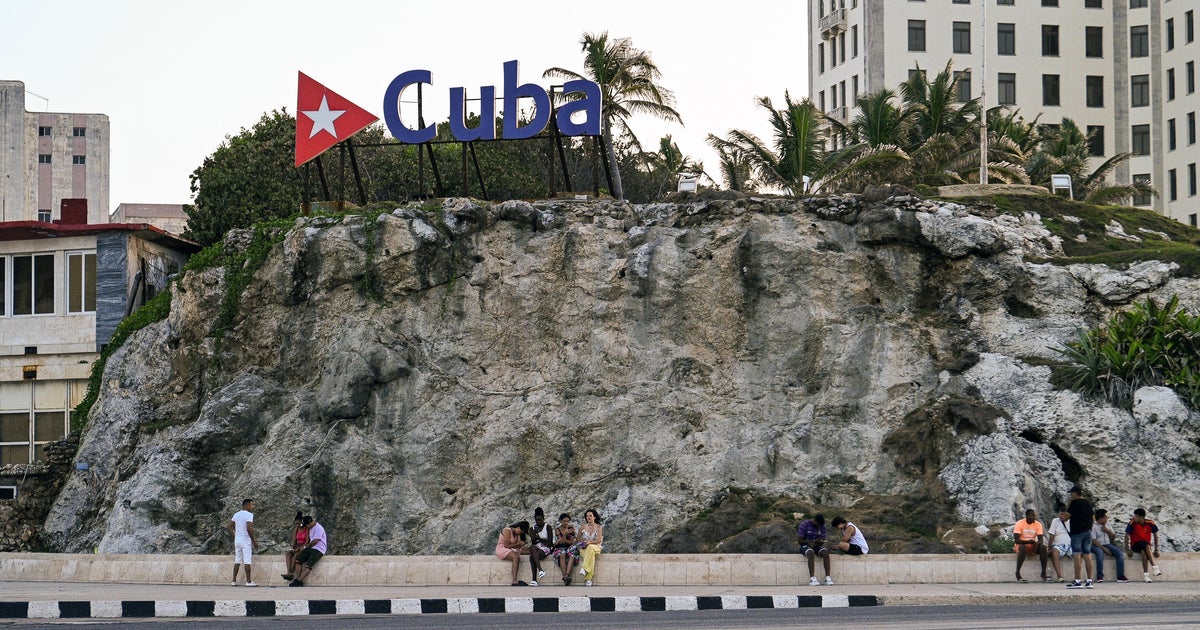
Washington – As the US-Iran war resumes following the collapse of a weeks-long ceasefire, top Pentagon officials are also quietly looking at another point much closer to home: Cuba.
Military planners in recent weeks have explored a number of options for possible action on the island, including an Army-led air assault involving thousands of US troops to be carried out by the 101st Airborne Division, the only division trained for such a mission, according to multiple US officials with knowledge of the discussions.
The officials, who spoke to CBS News on condition of anonymity to discuss national security issues, stressed that the comments were not an indication that President Trump or the Pentagon had decided to carry out the operation.
Any engagement with Cuba will present the Pentagon with a major problem because most of the attention of the US military and other important offensive capabilities are already committed elsewhere. Secretary of State Marco Rubio emphasized that the US prefers the diplomatic option of transition to a new government led by experts and is willing to make economic reforms. That process has stalled, despite mounting financial pressure on the Cuban military and its GAESA agency, a military-controlled holding company that the United States calls an $18 billion trust fund. In a statement on July 11, Rubio said that until now, the regime and its “corrupt officials” continue to refuse reform, instead “perpetuating their total control” and adhering to “an immoral Marxist ideology.”
The State Department announced that it has re-tightened financial sanctions on Cuban government companies that “invest money in the government and the military” that oppress the Cuban people, including rapid response officials.
Late last month, the U.S. military held a concept-of-operations briefing to discuss ways to advance military planning for select missions, officials said. Such briefings are often developed by the Department of Defense and military commands for contingency lists that assess mission objectives, number of troops required, sequence of events, planning considerations and related risks.
The Pentagon has shifted aircraft, intelligence equipment and other resources from other regions of the region to the Middle East to continue operations against Iran. Officials who spoke to CBS News said a switch to Cuba would not be possible at this time, given the renewed military action against Iran last week.
Behind the scenes, the war with Iran has exposed some rifts between President Trump and Hegseth, an Army veteran and former Fox News host, according to sources familiar with the matter. Although Mr. Trump, who has at times praised Hegseth and various military operations during his second term, has privately expressed frustration with the progress of Operation Epic Fury, believing the administration missed an opportunity to avoid a major conflict earlier this year by rejecting Iran’s proposal to curtail its nuclear program, officials said.
Two U.S. officials told CBS News that Hegseth called for a confrontational approach to Iran, despite doubts expressed by Gen. Dan Caine, chairman of the Joint Chiefs of Staff, left the president increasingly dissatisfied as the military campaign has taken longer and more difficult than originally expected when the war began back in February.
During the US-Israeli war against Iran, Mr. Trump was angered by both Hegseth and Caine when they proposed limits on military operations. Others in the Defense Department and the interagency team also expressed frustration with Navy Adm. Brad Cooper, the commander of US Central Command, complaining that he oversold what the military could accomplish against Iran, one of the sources said.
White House spokesmen did not immediately comment.
Pentagon deputy press secretary Joel Valdez said, “We do not comment on contemplated military operations,” and added that the department also would not comment on Hegseth’s secret conversations with Mr.
Cuba has presented new security challenges. CBS News previously reported that Cuba had received drones of unknown origin. During a June 10 visit to the US naval base at Guantanamo Bay, Hegseth indirectly acknowledged the possibility of a threat to that installation.
“It would be foolish for the Cuban government to try to buy or obtain the types of weapons that can reach this base or the American country. They will be inviting this kind of conflict, not only do they not want it, but they cannot stand it,” he swore.
Cuba and the US have a long dispute over the facility – after the Cuban Revolution of 1959, Fidel Castro refused to issue the checks, saying the lease, signed in 1903, was invalid.
Hegseth admitted that the US presented a military option to Mr. Trump, but gave the opportunity for peaceful relations, said that the US hopes that soon it will be “a friend of the leadership of the Cuban government.”
CBS News reported in May that US intelligence officials have been assessing how Cuba will respond to US military action, as the Trump administration accuses Havana of strengthening ties with Russia, China and Iran. The intelligence community’s 2026 threat assessment shows Cuba more as an enabler for the country’s major rivals, rather than an independent threat. Notably, March’s assessment does not portray Cuba itself as a military power that threatens the US or describe Havana as an independent driver of instability.
In May, CIA Director John Ratcliffe traveled to Havana for a rare meeting with top Cuban officials, using the visit to convey the message that the US was willing to expand economic and security cooperation with Cuba if Havana “made fundamental changes.”
But Ratcliffe also came with one of the staff members who participated in the U.S. mission to kidnap Venezuelan leader Nicolás Maduro in January, making a point of presenting the military leader to the Cuban people as the one who killed their own people in Venezuela, several people familiar with the trip told CBS News.
Days after the visit, the Justice Department indicted 95-year-old leader Raul Castro and five others on charges dating back to 1996. the shooting down of two US planes. That case has led to speculation that Castro will be arrested in a campaign similar to the kidnapping and seizure of Maduro. Multiple sources told CBS News that the Castro family’s preference would be to leave the island of their own free will, and that was a nod to the Trump administration’s meetings with Castro’s grandson Raulito.
The administration’s conflict with Cuba did not emerge overnight. In the past 18 months, the White House has partially dismantled the limited dialogue that was carried out under former Presidents Joe Biden and Barack Obama and replaced it with a campaign of economic, diplomatic and legal pressure that has isolated Havana and stripped it of its security tools to get money in an effort to force political change.
Cuba policy since Trump returned to office
A few hours after returning to office in January 2025, Mr. Trump reversed one of Biden’s last foreign policy decisions by reinstating Cuba’s designation as a state sponsor of terrorism, a move that also limited Cuba’s access to international finance and marked a return to the “high pressure” strategy of Mr. Trump’s first term.
The Trump administration expanded that approach when Rubio reinstated restrictions on business with Cuba’s military-controlled agency, GAESA, saying the military — not Cuba’s private sector — controls much of the island’s struggling economy. Weeks later, the State Department expanded visa restrictions targeting Cuban medical trips overseas, accusing Havana of exploiting doctors and nurses through a government-run export program that Cuban officials insist is voluntary.
Deputy Foreign Minister Carlos Fernandez de Cossio told the Associated Press in June that the Trump administration was trying to discourage thousands of Cuban doctors working around the world while cutting off an important source of income for the island nation.
Despite the growing tension, limited cooperation continued, including Cuba’s acceptance of planes deported from the US under existing migration agreements. In mid-2025, the Trump administration formalized its approach through a Presidential National Security Memorandum that increased restrictions on travel, currency issuance and financial transactions, while strengthening embargo enforcement.
This campaign was very intense at the beginning of this year when Mr. Trump declared Cuba an “unusual and extraordinary threat” and extended sanctions against foreign governments and companies that supply the island with oil. Additional measures include sanctions against top Cuban officials, as well as sanctions against Cuban President Miguel Diaz-Canel and other top officials.
These measures coincide with the critical economic situation in Cuba, characterized by fuel shortages, power outages and protests. Cuban officials blame US sanctions, while the Trump administration points to internal mismanagement.