Learning Campus An Inclusive and Effective Workplace
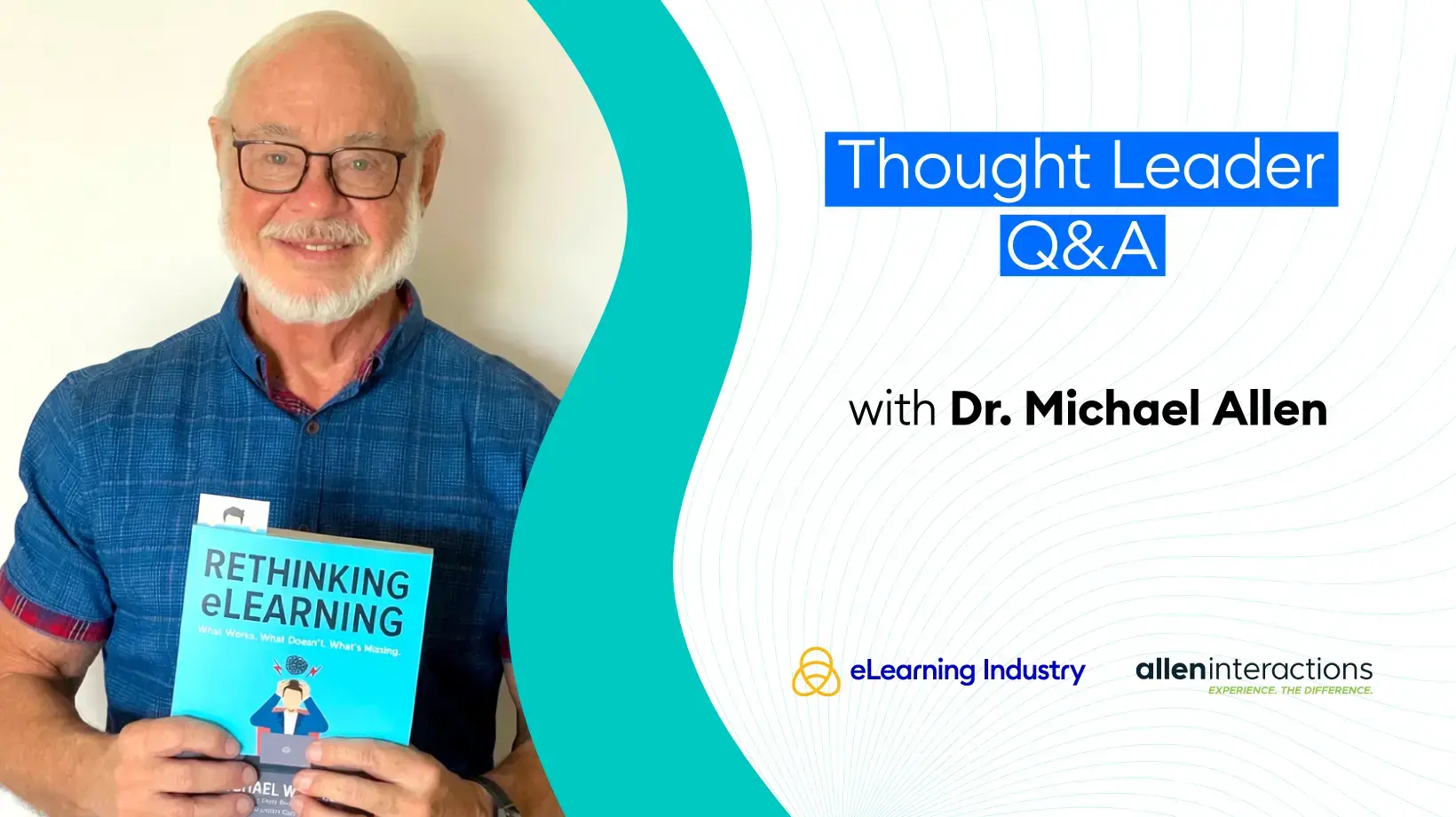
Michael W. Allen, PhD, has been a pioneer in the eLearning industry since 1970. His core work focuses on cognitive engagement, focused design, and innovative training methods that truly engage students. He developed the basic design models used in Allen Interactions, including the CCAF (Context, Challenge, Activity, Feedback) framework and the SAM (Successive Approximation Model) process. Dr. Allen is also a prolific author—he has written or edited nine books on effective eLearning, including Michael Allen’s Guide to e-Learning—and has received notable honors such as the Ellis Island Humanitarian Award, the Association for Talent Development (ATD) Award for Distinguished Contribution to Workplace Learning and Performance, and recognition as a Guild Master by the Learning Guild.
Today, we discuss effective workplace learning design for emotional engagement and lasting behavior change.
In chapter 1 of Rethinking eLearningyou describe the “revelation of relevance” from the Northside Achievement Zone project and how it changed your thinking. How does that same understanding apply to business learning environments where employees often drop out because the training seems useless?
Regardless of age, who wants to learn something that seems pointless? No one. It is difficult to pay attention, focus, and engage, yet we ask employees to do just that when we have failed to address the clear personal strengths and benefits our training provides students. If our training does not provide such benefits, we must ask ourselves, why are we putting our people through this?
Why do so many organizations continue to rely on content-centric, “broadcast-style” digital learning and even the best available technology—and what are the costs in terms of talent retention and performance?
Content streaming is emerging and strengthened by several factors.
- That’s what most of us were taught in school, so it’s the de facto standard.
- When training development begins, designers often jump into the content immediately.
- Ensuring that content is complete, accurate, and concise is a relatively straightforward task. Creating an engaging educational experience requires more creativity and expertise.
However, training that doesn’t train is very wasteful and ultimately more expensive than other training. Experiential training fosters operational confidence and readiness to transfer training to on-the-job performance, while the internal culture dramatically increases retention.
We walked you through how the 3Ms (Meaningful, Memorable, Motivating) framework, paired with differentiated authentic practice and CCAF collaboration, creates the emotional engagement needed for lasting change.
First, a counterexample: You can read a little about or watch a talented violinist or business leader, perhaps to the extent that you can speak knowledgeably about what they do. But can you do it? Can you be confident when you go up on stage?
The 3Ms, differentiated authentic practice, and CCAF provide an important framework for engaging and dynamic learning, especially by adding empathy—tuning the learning experience to how students feel, not just how well they do. Combining these components makes the learning experience feel as if it was designed for each student, as helpful and insightful as their mentor. The results? Not only learning, but also a positive attitude and strong self-confidence, with motivation about employing newly developed skills.
How can leaders use structured, one-on-one approaches, and short distributed sessions to reduce resistance and build real capacity outside of large groups?
If I list all the requirements, the task of creating training can seem overwhelming. But in reality it is not; it’s just different. In a way, it’s easy. Here is a summary:
- What can you ask the students to do that will prove to you and to them that they have learned the skills they need to learn? Create this interaction first.
- Look at the mistakes students might make and create a small learning module to address each possible mistake. You can do this easily by using the components of #1.
- Check each microlearning module in the same way and create additional microlearning modules to deal with possible errors in them if necessary.
- Iterate as needed until you have a learning experience that covers the basic needs your students may have.
Although this design is a step back from the traditional approach of starting with the basics and working, it saves time by reusing parts. He also developed individualized methods. Whether students face the final challenge first determines what needs they have and don’t have. You can now do the equivalent of the instruction going forward by requesting the necessary microlearning modules.
Looking ahead, what does the future of active learning in the workplace look like when organizations fully embrace the principles Rethinking eLearning?
Which is fun. It looks like reading is fun. Students will not be bored or frustrated by feeling forced into training that is below their abilities, beyond their abilities, or irrelevant to their needs. They will find that CCAF provides a video game-like environment that is fun in itself and a valuable use of their time because, as they overcome challenges and move up, they learn skills that will be important on the job, not just within the confines of the game.
For employers, they will get an ROI they can’t even imagine today, as well as improved competition in their field that will make all stakeholders very happy, indeed.
Wrapping up
We are very grateful to Dr. Michael Allen for sharing his insights on how to develop real talent through learning in a relevant and emotional workplace. Explore these ideas in depth in the new book by Dr. Allen, Rethinking eLearning: What Works. What It Doesn’t Want. What is missing. Contact Allen Interactions to start designing the kind of learning experience your organization—and your people—deserve.