Understanding SaaS LMS
As business learning continues to evolve, organizations are under increasing pressure to deliver training that is scalable, consistent, and relevant to business operations. With distributed teams, multiple stakeholders, and increasing compliance requirements, choosing the right Learning Management System (LMS) has become a strategic decision rather than a technical one.
One of the most common questions organizations face is whether to get a SaaS-based LMS or invest in a custom-built LMS. While both methods offer distinct advantages, the decision becomes more difficult as business needs grow and vary.
Understanding SaaS based LMS
A SaaS-based (Software-as-a-Service) LMS is a ready-to-use platform hosted and managed by a vendor. Organizations can sign up for these platforms and start deploying learning programs quickly without significant infrastructure investment. Key benefits of a SaaS-based LMS include:
- Fast implementation and deployment.
- Reduce upfront costs.
- Updates and maintenance managed by the vendor.
- General characteristics of general training requirements.
However, SaaS-based LMS platforms are generally designed to serve multiple users. As a result, they may not fully satisfy the specific needs of large businesses. They also have some common limitations:
- Limited customization of workflows and features.
- Challenges in integrating with complex business systems.
- Difficulty managing multiple user groups in one place.
- Relying on vendor roadmaps and feature updates.
For organizations with specific learning needs, SaaS-based LMS solutions can be effective. But as complexity increases, limitations become more apparent.
Understanding a custom LMS
A custom LMS is designed and developed specifically for the unique needs of an organization. It offers full control over features, workflow, and integration, making it ideal for businesses with special needs. Key benefits of a custom LMS include:
- It is fully designed for business processes.
- Maximum flexibility in design and operation.
- Ability to support complex workflows and integrations.
- Greater control over data and system behavior.
There are also some challenges associated with a custom LMS:
- High initial development costs
- Long periods of use
- Continuous maintenance and technical management
- Scaling challenges if not designed properly
While custom LMS solutions offer great flexibility, they require a significant investment and long-term commitment.
The Real Challenge: Enterprise Learning At Scale
For many organizations, the real challenge is not just choosing between a SaaS-based and a custom LMS. Manages learning across multiple business sectors, including:
- Employees in different departments.
- External partners and vendors.
- Compliance driven training programs.
- Continuous learning and professional development programs.
In such cases, disconnected systems often lead to inefficiencies, inconsistent learning experiences, and increased operational complexity.
Price Comparison
Understanding cost structures is important when evaluating LMS options. Each model has a different pricing approach, which affects long-term scalability and Return On Investment.
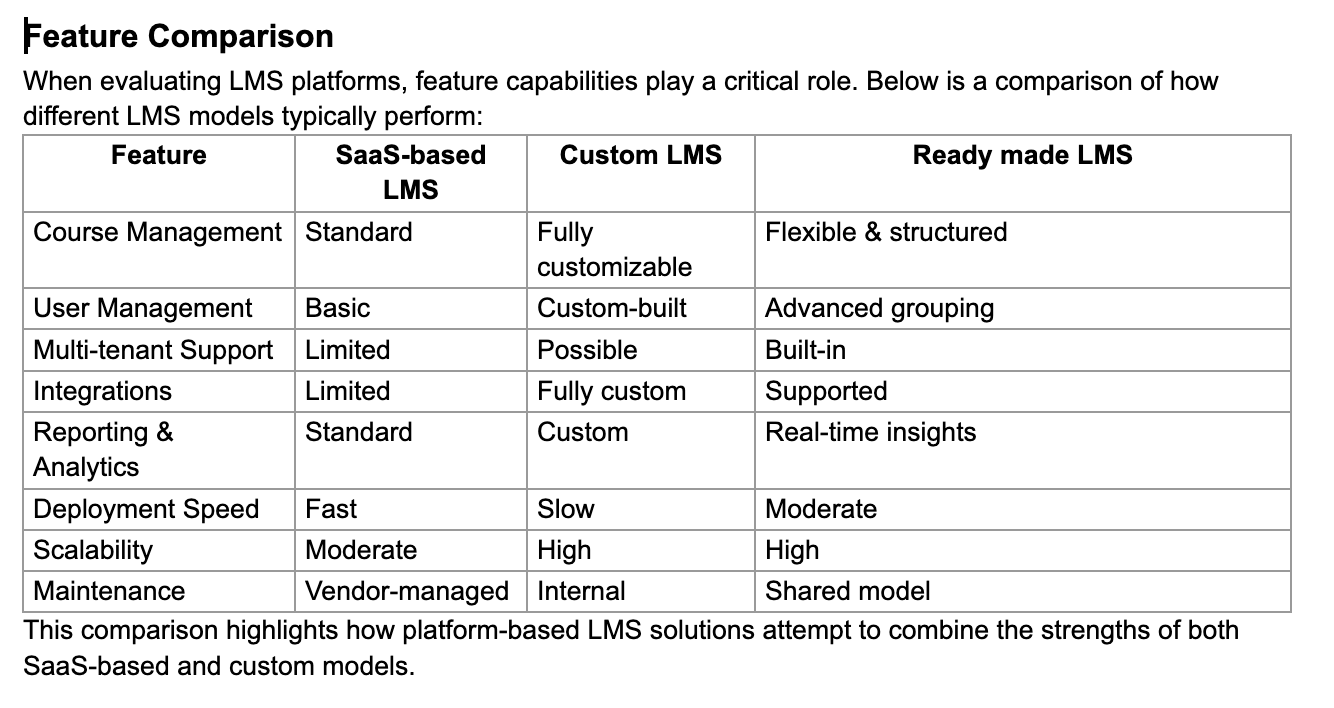
This comparison highlights how on-premises LMS solutions attempt to combine the strengths of both SaaS-based and custom models.
The Rise of Platform-Based LMS
In recent years, many businesses have started to move towards location-based LMS solutions. These systems are designed to provide a balance between flexibility and scalability without requiring complete custom development. Instead of building everything from scratch or relying entirely on solid SaaS-based tools, platform-based LMS solutions provide a structured foundation that can be expanded as needed. Key benefits include:
- It supports multiple user groups within a single system
- It enables a consistent learning experience across teams
- Adapts to evolving business requirements
- Reduce fragmentation between tools and systems
This approach is particularly useful for organizations that need to manage learning at scale without continually rebuilding their systems.
Key Business Considerations
When choosing an LMS, organizations should focus on long-term alignment rather than short-term convenience. Important factors to consider include:
- Ability to scale with organizational growth
- Flexibility to support learning changes
- Integration with existing business systems
- Total cost of ownership over time
The goal is not just to start a learning program, but to build a foundation that can support ongoing learning and development efforts. The decision between a SaaS-based LMS and a custom LMS is no longer an easy choice. As business learning becomes more complex, organizations are looking beyond traditional models. SaaS-based LMS platforms offer speed and simplicity, while custom LMS solutions offer flexibility and control. However, both methods have limitations when applied to a large, dynamic environment.
That’s why platform-based LMS solutions are gaining momentum. They offer a balanced approach—combining scalability, flexibility, and streamlined delivery—that makes them the perfect fit for today’s businesses. Ultimately, the right choice depends on how well the system fits your organization’s current needs and future growth.
Photo credits:
- Tables within this article were created/provided by the author.